Showing posts sorted by relevance for query Relief sculpture. Sort by date Show all posts

Sunday, January 30, 2011

Definisi Arca Relif

sumber:

http://www.cantorfoundation.org/Education/guidea3.html

Sculpting in Relief


OBJECTIVE

By discussing the different styles of relief sculpture, and by being introduced to the appropriate techniques, students will be able to create their own sculptures in relief.

VOCABULARYrelief sculpture (alto, mezzo and bas), free-standing sculpture, composition, subtractive, additive

MATERIALS
  1. Pictorial examples of reliefs
  2. Clay
  3. Sculpting tools
  4. Rolling pin
  5. Water and/or spray bottle
  6. Working boards/working surface (masonite, cardboard etc., newspaper)

BACKGROUND
The technique of sculpting in relief has been widely used since ancient times throughout many different cultures. Reliefs are often integrated with architechtural structures such as churches and cathedrals. They are also used for simple, everyday objects such as coins.

A relief is characterized according to the depth of the projection from the flat surface.
The three categories are:
Alto rilievo (Italian for 'high relief') Sculpture is carved deeply enough as to suggest that the components of the design are almost completely detached from their background support.
Mezzo rilievo (Italian for 'middle relief') Sculptural objects are projected in the "half-round", which means that half of their volume projects from the surface.
Basso rilievo (Italian for 'low relief', also known as bas-relief) Sculptural figures or objects project less than half of their "true depth" from the background plane.

Rodin's Gates of Hell is a monumental example of high relief sculpture. Hundreds of mingling and intertwining figures project from a flat background. Many of the figures are carved so deeply into the background that they appear to be almost detached from it.

PROCEDURE
Using examples, introduce students to relief sculptures and discuss their characteristics. Select one of the following methods, then have students roll out a slab of clay (can be square, rectangular, round, or oval).

Attaching relief to a clay slab:
This is a good project for beginners.

  1. Students should choose a subject to depict and think of it in terms of individual shapes. Have students make a sketch of the composition, mapping out the shapes of the object.
  2. Students can make each shape in clay, either by rolling balls or modeling the forms with their hands.
  3. Place the shapes on the clay slab in the desired composition.
  4. After all the shapes are in place, gently join the shapes with the clay slab by pressing and smoothing the edges of the form. Work the shapes by hand and begin giving them definition.
  5. Smooth the edges of the shapes using clay tools making certain that it is sufficiently attached to its base.
  6. Using clay tools, students can now add texture and details so that the relief stands out from the background.

Modeling a relief in clay:
This method requires more planning and hand dexterity. It is a good way to explore different levels of relief in one composition.

  1. Using a sculpting tool or a pencil, students can lightly draw the main shapes of their desired subject onto their slab. Remind them not to dig too deep into the clay or it may separate into pieces.
  2. Now using their fingers, thumbs, and tools, students should push back the clay surrounding the subject so that it is in low relief.
  3. Students can now use tools and any other interesting items to create texture and add details.

If the students want to make their reliefs into wall plaques, using a pencil or clay tool, poke a hole ½ " from the top of the slab. Don't make the hole too small as the clay will shrink as it dries. After they are finished they can be fired or air-dried (will not be waterproof if not fired).

** Make sure students keep the clay moist, applying water to cracks with their fingers or using a spray bottle. If students do not finish in one class session be sure to have them cover their sculptures in plastic so that they do not dry out.

EXTENSION

  • Have a "relief hunt" in which students report on relief sculptures they find in everyday life.
  • Experiment with reliefs using other media such as papier-maché reliefs.

Sunday, May 22, 2011

Catan Relief atau Arca Relief?


Catan Relief atau Arca Relief?

Di bawah ini, merupakan petikan penulisan mengenai Catan Relief dari sumber http://www.toutfait.com/issues/volume2/issue_5/artandliterature/krank/krank.html

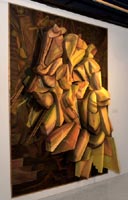
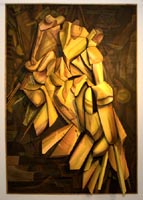
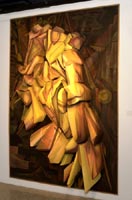
It seemed natural to offer this advancement to the Nude Descending a Staircase, No. 2 (Fig. 1) by Marcel Duchamp. Duchamp’s Nude had been created to show the dynamic motion of a young lady as she descended the stairs, but the painting remained on a flat surface, the woman described in mostly hard, angular lines. I wanted to take the figure and allow her to emerge as a three-dimensional woman while keeping the intensity and power of her movements. I wanted to combine those hard, angular lines with the organic feel that Duchamp only suggests. To keep the feeling of the force of her body as she moved downward, I needed her to be big–nearly nine feet tall.

I named her Nude Redescending a Staircase (Fig. 2). She begins at a physical distance, the forms in the upper left corner of the work extending only about an inch off the surface. Then, as she descends (or redescends) she gradually increases into the viewers space coming forward a full 22 inches. The oblique angles allow her to have an abstracted actual figure with illusions of light moving and playing across her form. Each individual piece is slightly rounded. Even the hardest edges have a gentleness about them thanks to the cotton ground.

click to enalrge
Figure 2
Sarah C. Krank, Nude Redescending a Staircase

sumber
http://www.toutfait.com/issues/volume2/issue_5/artandliterature/krank/krank.html

Kalau tak faham, cikgu cerita sikit. Karya di atas adalah penghasilan semula karya daripada karya artis terkenal Marcel Duchamp (gambar di bawah). Karya catan yang bertajuk 'Nude Descending A Staircase No. 2' telah diolah semula oleh Sarah C. Krank dengan mengaplikasi teknik relief atau timbulan dalam karya dan terhasillah karya seperti di atas bertajuk 'Nude Redescending A Staircase'.


Ini pula definisi untuk basso-relief (low relief/relif rendah)


A French term from the Italian basso-relievo ("low relief"), bas relief is a sculpture technique in which figures and/or other design elements are just barely more prominent than the (overall flat) background.

Bas relief is created either by carving away material (wood, stone, ivory, jade, etc.) or adding material to the top of an otherwise smooth surface (say, strips of clay to stone). This is a technique as old as humankind's artistic explorations, and is closely related to high relief.

pautan untuk penerangan sejarah dan jenis-jenis relief yang lengkap http://www.newworldencyclopedia.org/entry/Relief_(sculpture)


Saturday, January 15, 2011

Perbincangan Soalan 2 - Kasih Ibu

2 Hasilkan sebuah karya seni visual yang bertemakan “Kasih Ibu”. Hasil karya anda hendaklah
menggunakan bahan yang sesuai dengan tema. Persembahan karya hendaklah dalam bentuk relif
atau tiga dimensi (3D).
Hasil karya relif hendaklah berukuran tidak melebihi 40 cm × 60 cm. Hasil karya tiga dimensi
(3D) pula hendaklah berukuran tidak melebihi 40 cm tinggi, 25 cm panjang, dan 25 cm lebar.
Portfolio karya seni hendaklah mengandungi
• kajian dan penyelidikan berdasarkan tema
• lakaran perkembangan idea
• lakaran akhir
• kajian media dan teknik
• pengolahan aspek-aspek komposisi dalam gubahan karya
• rujukan dan sumber maklumat

Nota: Semua proses yang dijalankan untuk menghasilkan karya perlu didokumentasikan
mengikut urutan.
Hasil karya hendaklah diberi penekanan dari aspek
• ketepatan tema dan makna
• penerokaan media dan teknik
• pengolahan aspek komposisi
• pertimbangan estetik
• keaslian
• kemasan
Nota: Karya hendaklah dihasilkan secara manual.


Kehendak Soalan 2 ni senang nak faham kan... Ikut saja step folio http://cikgusenismkbk.blogspot.com/

Beberapa tips dari cikgu :

1. Soalan minta anda hasilkan karya dalam bentuk relief atau arca (3D). Relief maksudnya timbulan. Kalau nak cari bahan di internet, kata kunci 'relief painting' atau 'relief sculpture'.
Beberapa contoh:
contoh 'bas relief' atau relief rendah

Arca 'high relief' atau relif tinggi

Catan Relief sebegini tidak sesuai rasanya untuk jawab soalan 2, kena kaji pensejarahan karya relief .

2. Gaya Penampilan juga perlu dipertimbangkan
a. realistik
b. semi-realistik
c. abstrak

3. Pengaruh aliran karya dan artis yang mempengaruhi karya kamu.

4. Kemasan kerja. Kena frame nanti, so simpan duit. Jangan asyik beli top up ja...

Monday, May 23, 2011

Teknik Relif dalam Kasih Ibu

Kepada guru dan pelajar Seni Visual STPM 2011, cikgu minta maaf jika penulisan sebelum ini mengelirukan. Cikgu dah tarik balik entri sebelum ini yang bagi cadangan teknik media campuran dalam menjawab soalan no 2 Kasih Ibu. Di facebook Seni Visual STPM, En Hassan telah menjelaskan bahawa untuk soalan 2 Kasih Ibu, karya yang dihasilkan tidak boleh menggunakan teknik kolaj/media campuran. Bermakna, pelajar perlu gunakan teknik arca Relif sahaja seperti di http://cikgusenismkbk.blogspot.com/search?q=Relief+sculpture